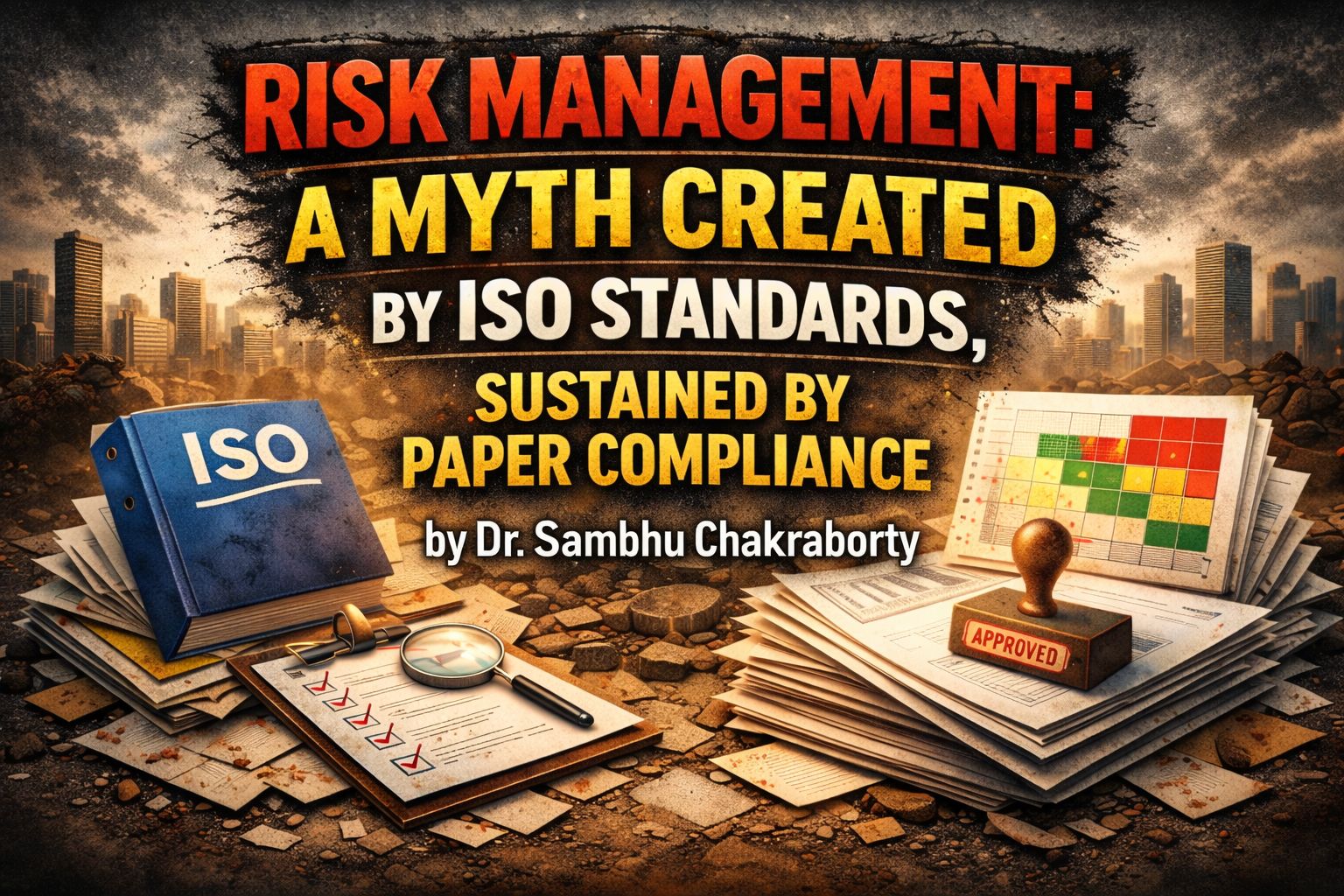

Risk management is presented as the central pillar of almost every ISO-series Quality Management System standard. From ISO 9001 to ISO 15189, ISO/IEC 17025, ISO 13485, and beyond, the language is consistent and assertive: risk-based thinking, identification of risks, evaluation of risks, mitigation actions, and continual improvement.
In theory, risk management is indispensable. It is relevant to business sustainability, production integrity, patient safety, laboratory accuracy, clinical outcomes, and decision-making from sample receipt to final report issuance. No competent professional disputes its conceptual value.
Yet the reality across certification and accreditation systems tells a very different story.
Risk management, as demanded by ISO standards, is largely a constructed concept—designed for documentation, not for real implementation.
⸻
The Ground Reality: Risk Management as a Fabricated Narrative
In practical implementation, almost every organization prepares a manufactured risk narrative. Risk registers, probability-impact matrices, color-coded heat maps, and mitigation plans exist primarily to satisfy auditors—not to drive operational decisions.
Risk thinking does not guide the process; the process guides the paperwork.
Quality teams rarely ask:
• “What can realistically go wrong today?”
• “Where is the system most vulnerable?”
• “What failure would actually harm patients, customers, or credibility?”
Instead, they ask:
• “What risk examples will auditors accept?”
• “Which risks look safe enough on paper?”
• “What mitigation wording will close the clause?”
Risk calculation becomes retrospective, not preventive. It starts after systems are already running—and often after problems have already occurred.
⸻
Why This Failure Is Systemic, Not Accidental
This is not due to laziness or lack of integrity among quality professionals. It is the inevitable outcome of how ISO standards define and position risk management.
1️⃣ Abstract Requirements Without Operational Anchoring
ISO standards deliberately describe risk management in high-level, generic language. They avoid sector-specific depth and avoid prescribing methods. While this is defended as “flexibility,” in reality it results in ambiguity.
A single clause on risk management is expected to work equally for:
• A clinical laboratory handling life-critical results
• A manufacturing unit producing mechanical parts
• A service organization delivering consultancy
• A multinational corporation with layered governance
This one-size-fits-all philosophy ignores the fact that risk is inherently process-specific and technically complex. Without deep operational anchoring, risk management becomes symbolic.
⸻
2️⃣ Certification and Accreditation Bodies Cannot Demand Reality
Conformity Assessment Bodies (CABs) are structurally incapable of enforcing genuine risk management.
True risk assessment requires:
• More audit time
• Higher technical competence
• Engagement with frontline processes
• Challenging uncomfortable truths
But CABs operate under:
• Time pressure
• Commercial competition
• Fixed audit durations
• Client-retention incentives
As a result, auditors verify existence of documents, not effectiveness of risk controls. Risk management becomes a checklist item, not a system behavior.
⸻
3️⃣ Management Resistance Is Built Into the System
Real risk management is expensive. It exposes weaknesses, demands corrective investment, disrupts routines, and forces accountability.
Top management quickly understands that:
• Genuine risk mitigation costs money
• Risk transparency creates liability
• Open discussions can challenge authority
• Paper compliance achieves certification at minimal cost
So risk management is tolerated as paperwork, not encouraged as practice. The system quietly teaches everyone: Do not dig too deep.
⸻
4️⃣ Standards Are Written by Those Distant From Implementation
Perhaps the most uncomfortable truth is this:
Many who design ISO risk-management requirements have never conducted real-world, end-to-end risk assessments in operational environments.
They are often:
• Policy experts
• Standardization professionals
• Committee representatives
• Administrative or regulatory figures
They understand clauses, terminology, and frameworks—but not:
• Human behavior under pressure
• Data gaps and uncertainty
• Resource constraints
• Operational shortcuts
• Fear of blame and punishment
As a result, standards describe an idealized, friction-free world that does not exist in daily operations.
⸻
Why Generic Risk Management Will Always Fail
Risk management cannot succeed as a standalone activity or a quality-department function.
Generic tools—risk registers, matrices, scoring systems—become meaningless when they are not:
• Embedded in daily workflows
• Owned by process owners
• Linked to real decisions
• Supported by leadership
• Aligned with economic reality
Risk management only works when it is specific, localized, and operationally inseparable from the core process—whether that is testing, validation, reporting, manufacturing, or service delivery.
Without this, risk management becomes a ritual performed once a year for auditors.
⸻
Writing Requirements Is Easy. Living Them Is Not.
ISO standards excel at writing elegant requirements. They struggle with implementation realism.
The belief that organizations can achieve “risk-based thinking” through documents, meetings, and registers is a convenient illusion. Risk management is not a form, not a matrix, not a file stored for audits.
It is a behavioral system, shaped by:
• Culture
• Competence
• Cost tolerance
• Fear and incentives
• Leadership maturity
Until ISO standards:
• Incorporate real implementation experience
• Demand process-level evidence over documents
• Recognize economic and human constraints
• Accept sector-specific risk models
Risk management will remain a construct—created by standards, maintained by paperwork, and disconnected from reality.
The system will continue to look compliant, structured, and mature on paper—while real risks quietly persist beneath the surface.
About the Author
Dr. Sambhu Chakraborty is a distinguished consultant in quality accreditation for laboratories and hospitals. With a leadership portfolio that includes directorial roles in two laboratory organizations and a consulting firm, as well as chairman of International Organization of Laboratories ( An ILAC stakeholder organisation), Dr. Chakraborty is a respected voice in the field. For further engagement or inquiries, Dr. Chakraborty can be contacted through email at info@sambhuchakraborty.com and contact information are available on his websites,https://www.quality-pathshala.com and https://www.sambhuchakraborty.com , or via WhatsApp at +919830051583.