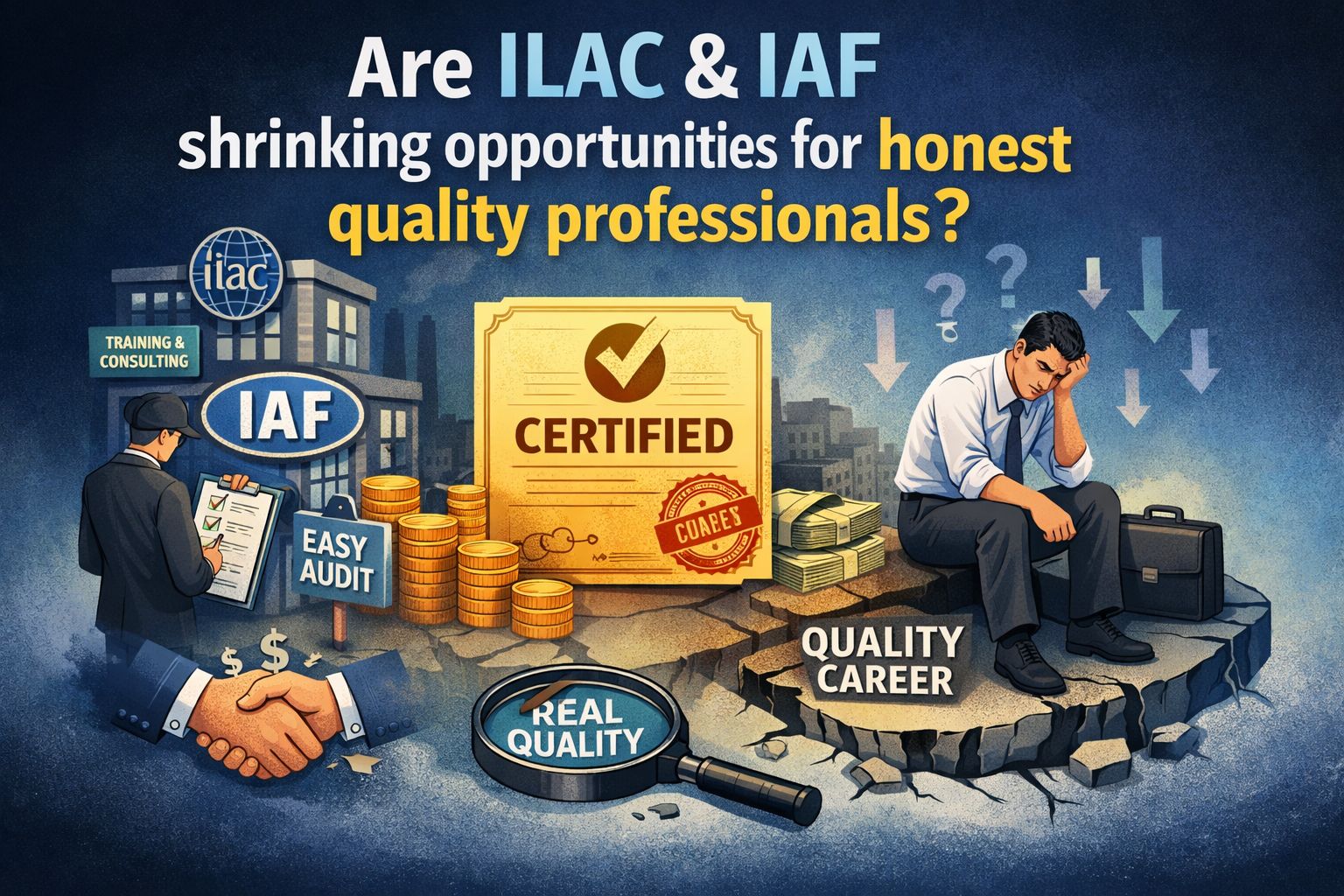

Accreditation was originally designed to strengthen competence, impartiality, and trust in conformity assessment. Quality professionals—consultants, assessors, technical experts, and trainers—were meant to be the backbone of this ecosystem. However, over time, serious concerns have emerged about whether the global accreditation structure led by ILAC and IAF is unintentionally (or systematically) eroding the relevance and working opportunities of honest quality professionals.
What follows is not an emotional allegation, but a field-based analysis grounded in what many professionals are experiencing globally.
1) Accreditation Bodies Offering Training and Consulting: A Direct Conflict
Accreditation Bodies (ABs) are increasingly offering training, awareness programs, implementation guidance, and even consulting-like services—directly or through affiliated entities. This creates a structural conflict of interest.
When the same system that evaluates competence also influences preparation, independent quality consultants lose relevance. Clients prefer “accreditation-friendly” training aligned with assessors’ expectations rather than genuine system building. The outcome is simple: independent quality professionals are crowded out.
2) Eye-Wash Assessments and Ignoring Real Quality Work
Assessments are often reduced to document verification, checklist ticking, and verbal assurances. Critical elements—technical competence, process capability, method validation robustness, uncertainty evaluation, risk-based decision-making—are frequently glossed over.
Such “eye-wash assessments” reward superficial compliance. When real quality work is not demanded, professionals who focus on substance rather than appearance find their expertise undervalued.
3) Certificate Assurance Culture Demotivates Quality Professionals
A dangerous mindset has taken root: “Accreditation is assured—whatever our preparation.”
When clients believe certification or accreditation is guaranteed:
• They resist investing time, effort, and money in real quality improvement
• They question the need for continuous professional support
• They see quality work as an unnecessary cost, not a value driver
This commercialized assurance demotivates quality professionals, because excellence and rigor are no longer rewarded—speed and payment are.
4) Assessors Advised to Avoid Regular CABs; Consultants Made Redundant
In many cases, assessors are subtly (or directly) advised:
• Not to “over-audit” regular clients
• Not to raise repeat nonconformities
• Not to disturb revenue-generating CABs
Clients quickly understand this pattern and exploit it. As scrutiny reduces, the consultant’s role in system strengthening becomes less important, limited to documentation cosmetics rather than improvement. This systematically weakens the profession.
5) Regional Cooperations Encouraging Quantity Over Quality
Regional cooperation bodies such as APAC, AFRAC, and IAAC rely heavily on peer evaluations and document-based assessments of Accreditation Bodies.
The system:
• Encourages rapid expansion of AB numbers
• Focuses more on formal compliance than governance, ownership, or conflict of interest
• Treats accreditation as a scalable business rather than a public-interest function
As ABs multiply, competition shifts toward ease of accreditation, not rigor—further reducing demand for serious quality professionals.
6) A Demotivated Environment with No Demand for Real Quality Work
The cumulative effect is a demoralized professional ecosystem:
• Young professionals see little future in rigorous quality practice
• Experienced professionals feel sidelined or ignored
• Ethical consultants struggle to survive in a “pay-and-pass” market
When demand for real quality work disappears, quality itself becomes symbolic—existing only in certificates, not in outcomes.
Conclusion: A System in Need of Course Correction
The issue is not accreditation itself, but how it is being commercialized, diluted, and protected by silence. Unless ILAC, IAF, and regional cooperations:
• Clearly separate accreditation from training/consulting
• Enforce assessor independence and technical depth
• Reward rigor instead of speed
• Restore the value of independent quality professionals
…the system risks destroying the very expertise it was created to uphold.
Without honest quality professionals, accreditation becomes a logo. Not a guarantee.
About the Author
Dr. Sambhu Chakraborty is a distinguished consultant in quality accreditation for laboratories and hospitals. With a leadership portfolio that includes directorial roles in two laboratory organizations and a consulting firm, as well as chairman of International Organization of Laboratories ( An ILAC stakeholder organisation), Dr. Chakraborty is a respected voice in the field. For further engagement or inquiries, Dr. Chakraborty can be contacted through email at info@sambhuchakraborty.com and contact information are available on his websites,https://www.quality-pathshala.com and https://www.sambhuchakraborty.com , or via WhatsApp at +919830051583