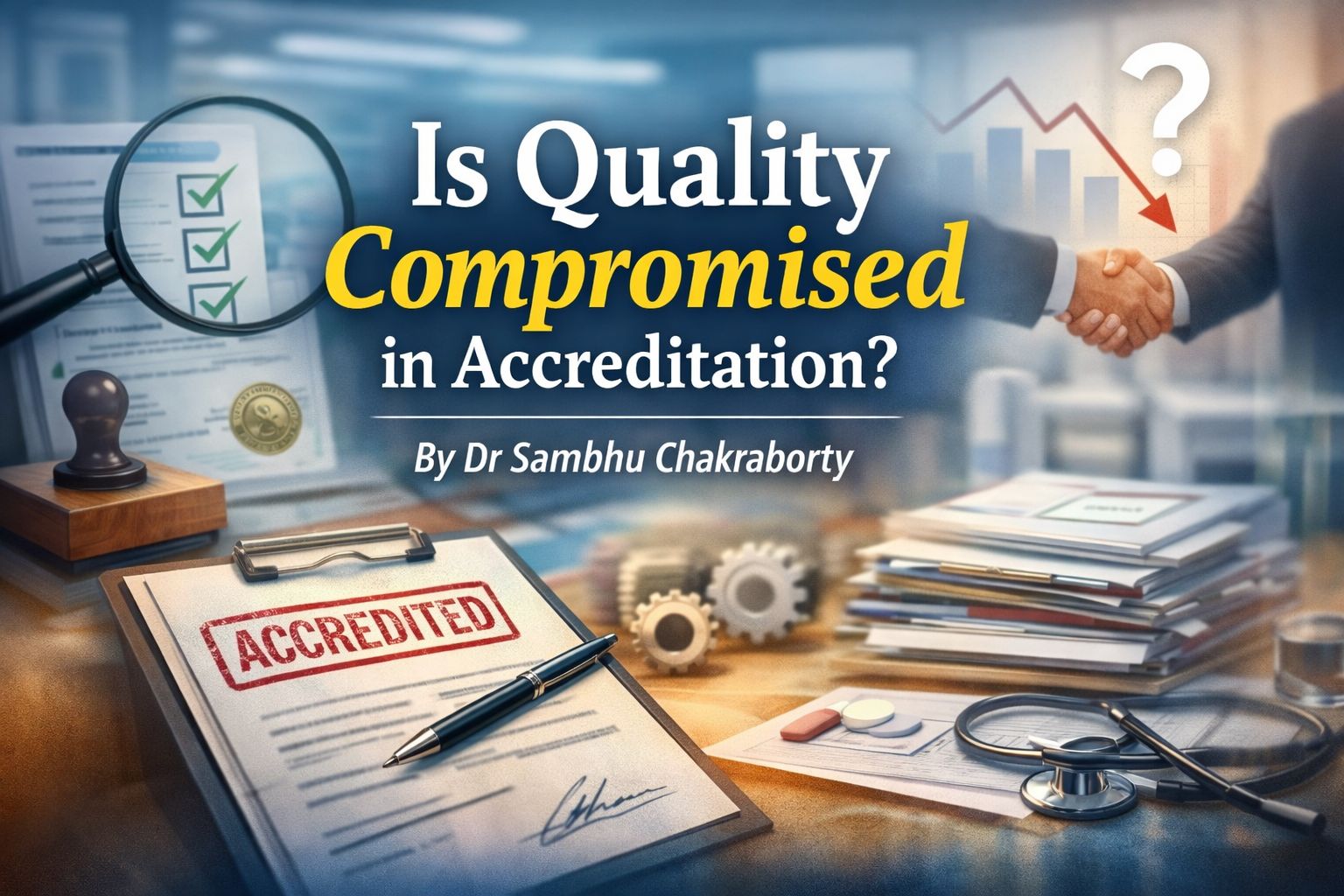

Accreditation was conceived as a structured assurance mechanism — a system that validates competence, consistency, and credibility. Whether it is National Accreditation Board for Testing and Calibration Laboratories (NABL), College of American Pathologists (CAP), or Joint Commission International (JCI), the intent is clear: to promote quality and safeguard public interest.
Yet an uncomfortable question persists:
Is quality sometimes reduced to paperwork once accreditation is achieved?
Accreditation: The Beginning or the End?
Accreditation is voluntary in many sectors. Organizations apply, prepare documentation, train staff, and undergo audits. During this preparation phase, systems are strengthened, processes are aligned, and documentation is structured.
However, a common pattern is observed:
• Intense preparation before audit
• Peak compliance during assessment
• Gradual dilution after certificate issuance
For some organizations, accreditation becomes the destination rather than the starting point of continuous improvement.
The certificate is displayed.
The logo is used.
Marketing gains momentum.
But internally, quality may slowly shift from practice to paper.
When Quality Becomes Documentation
Quality management systems are built on documentation — SOPs, records, internal audits, corrective actions, risk assessments. These are essential tools.
But tools are not outcomes.
When documentation exists primarily to satisfy auditors rather than to improve processes, quality turns transactional. Systems are maintained just enough to retain the certificate.
Typical warning signs include:
• Internal audits conducted mechanically
• Corrective actions written but not implemented deeply
• Quality indicators collected but not analyzed
• Management review meetings treated as formalities
• Staff trained for audit questions rather than competence
In such situations, accreditation survives — but quality weakens.
The Role of Accreditation Bodies
Accreditation bodies operate within defined standards and assessment frameworks. They verify compliance against documented criteria.
However, challenges arise when:
• Audits become predictable and routine
• Surveillance assessments are limited in depth
• Focus remains on minimum documentation compliance
• Commercial pressures influence assessment rigor
If clients perceive that maintaining minimal documentation is sufficient to retain accreditation, organizational motivation shifts from excellence to compliance.
Without strong regulatory oversight and governance mechanisms that periodically evaluate real performance outcomes — not merely documentation — sustained quality becomes fragile.
Is Audit Becoming Easier?
In mature accreditation ecosystems, audits are expected to be robust and improvement-driven. But if:
• Auditors focus mainly on records rather than real-time observation
• Nonconformities are minor and repetitive
• Outcomes are rarely linked to customer impact
Then audits may gradually lose their transformational strength.
When organizations sense that accreditation bodies prioritize business continuity and revenue over stringent evaluation, honest practice can erode.
Quality then becomes framed for audit purposes — not for patients, clients, or end users.
The Core Issue: Intent
Ultimately, accreditation cannot manufacture integrity.
Quality is not imposed by a checklist.
It is sustained by leadership commitment.
Two organizations may hold the same accreditation certificate:
• One lives quality daily.
• The other manages documentation strategically.
The difference lies in intent.
Quality is carried from Conformity Assessment Body (CAB) to CAB, shaped by culture, ethics, and accountability.
Beyond Certification: What Must Change?
To prevent compromise, the following are critical:
1. Outcome-based evaluation – Assess measurable performance indicators, not just records.
2. Unannounced assessments – Reduce audit staging.
3. Stronger governance and regulatory linkage – Accreditation must align with public accountability.
4. Transparent reporting of quality indicators – Encourage benchmarking.
5. Leadership accountability – Quality must be owned at the top.
Accreditation should be a continuous challenge, not a periodic event.
Conclusion
Accreditation, by itself, does not guarantee quality.
It provides a framework — a structured opportunity.
If organizations treat accreditation as a marketing achievement, quality may indeed end with certification.
But if accreditation is treated as a discipline of continuous improvement, it becomes a powerful engine of excellence.
In the end, quality does not depend solely on standards, auditors, or accreditation boards.
It depends on organizational honesty.
And honesty cannot be audited — it must be practiced.
About the Author
Dr. Sambhu Chakraborty is a distinguished consultant in quality accreditation for laboratories and hospitals. With a leadership portfolio that includes directorial roles in two laboratory organizations and a consulting firm, as well as chairman of International Organization of Laboratories ( An ILAC stakeholder organisation), Dr. Chakraborty is a respected voice in the field. For further engagement or inquiries, Dr. Chakraborty can be contacted through email at info@sambhuchakraborty.com and contact information are available on his websites,https://www.quality-pathshala.com and https://www.sambhuchakraborty.com , or via WhatsApp at +919830051583