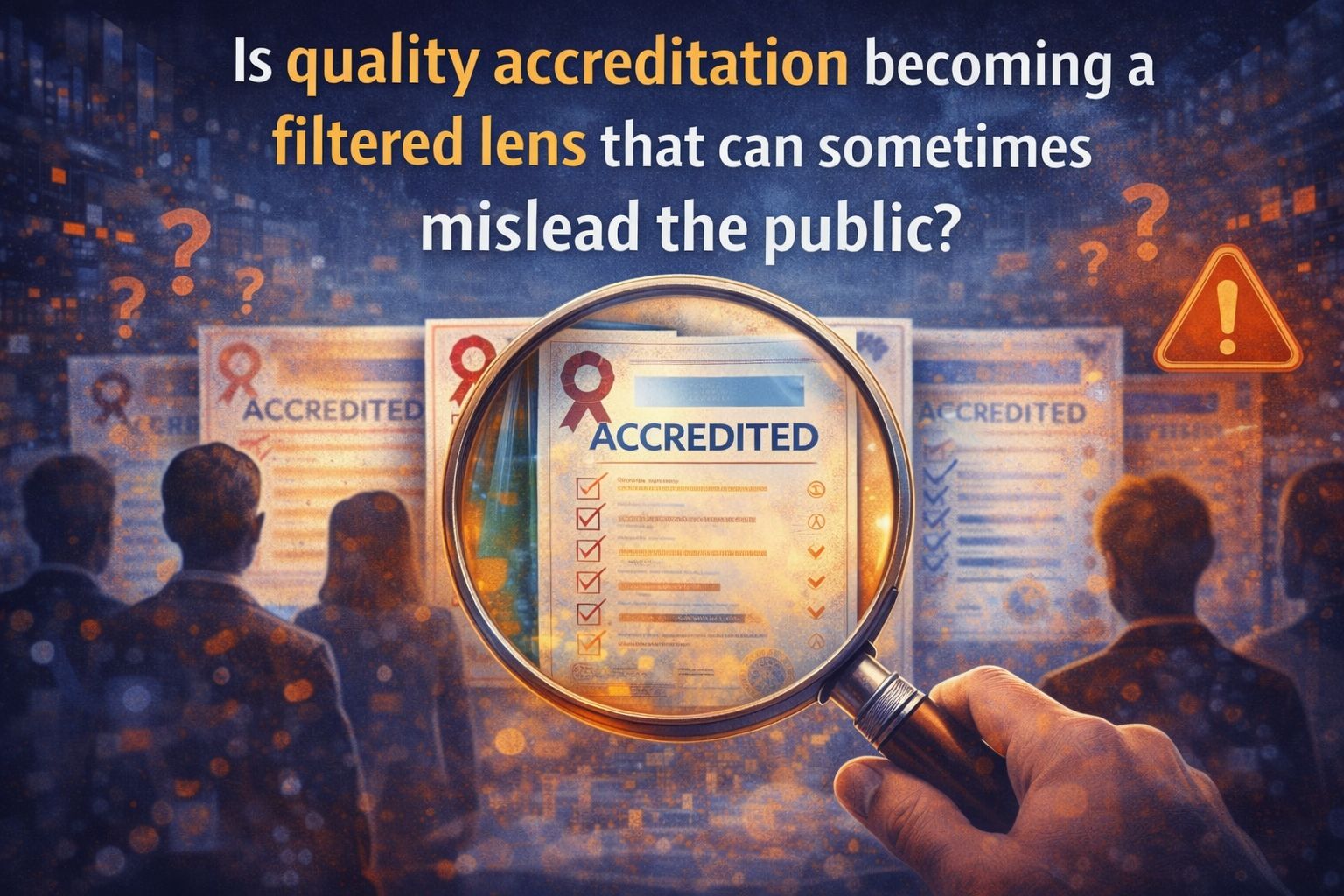

Accreditation was originally created as a trust mechanism. Its purpose is simple and noble: to assure the public that a laboratory, certification body, or organization is competent, reliable, and technically sound. In theory, when people see an accreditation logo, they should feel confident that the service or product has passed strict checks.
But in practice, many professionals across industries are beginning to ask a difficult question:
Is accreditation always a true measure of quality — or has it sometimes become a system that can be used as a marketing shield?
Let us examine this concern from practical ground-level realities rather than theory.
- Commercial Incentives and Certificate Revenue
Accreditation is not free. Organizations pay application fees, assessment charges, surveillance fees, renewal fees, and often training and consulting costs. For accreditation bodies, certification bodies, and related institutions, this becomes a structured revenue stream.
This does not automatically mean wrongdoing — many legitimate systems operate on fees. However, when a system depends financially on the number of certificates issued or maintained, a natural concern arises:
Can commercial pressure unintentionally influence strictness of assessments?
Even the perception of such pressure can affect public confidence.
- Sustainability of the Accreditation Ecosystem
Accreditation systems involve many stakeholders:
• accreditation bodies
• assessors
• trainers
• consultants
• proficiency testing providers
• certification bodies
This creates a large ecosystem where many professionals earn their livelihood. Such systems naturally develop mechanisms to sustain themselves. Again, sustainability is not wrong — it is necessary. But when sustainability becomes a dominant driver, there is a risk that:
maintaining the system may become more important than questioning its effectiveness.
Strong systems must always allow self-criticism and improvement.
- Brand Supremacy and Competitive Advantage
Accreditation logos often act as powerful brand symbols. Organizations proudly display them on reports, certificates, websites, and advertisements. In competitive markets, this can create a strong perception:
“Accredited means superior.”
While accreditation does indicate compliance with certain standards, it does not automatically guarantee that one organization is better than all others. Yet branding sometimes creates that impression.
When logos become marketing tools rather than quality indicators, the original purpose of accreditation can become diluted.
- Customer Attraction Through Perceived Assurance
Many clients select service providers simply because they see an accreditation mark. For customers who lack technical knowledge, the logo acts as a shortcut decision tool. This is understandable — not everyone can evaluate technical competence.
But this also means customers may rely entirely on the symbol rather than real performance data. If oversight is not visibly strong and transparent, the logo alone can create a false sense of security.
Accreditation should support informed decisions — not replace them.
- Survival Pressure in Competitive Markets
Organizations operate in competitive environments. Laboratories, inspection agencies, and certification bodies often feel that without accreditation they cannot survive commercially. As a result:
• some pursue accreditation mainly for market access
• some focus more on documentation than real practice
• some prepare intensely only before assessments
This is not universal, but it is a pattern widely observed across sectors. When survival becomes the main motivation, quality risks becoming secondary.
⸻
Final Thought
Accreditation itself is not the problem. In fact, it is one of the most valuable tools ever created to promote quality and confidence. The real issue is how it is implemented, monitored, and communicated.
A strong accreditation system should be:
• transparent
• independent
• consistently enforced
• openly accountable
When these elements are visible, accreditation becomes a true mark of trust.
When they are not visible, people begin to question whether the system is acting as a clear window — or as a filtered lens.
True credibility does not come from certificates alone.
It comes from continuous, visible proof of competence.
About the Author
Dr. Sambhu Chakraborty is a distinguished consultant in quality accreditation for laboratories and hospitals. With a leadership portfolio that includes directorial roles in two laboratory organizations and a consulting firm, as well as chairman of International Organization of Laboratories ( An ILAC stakeholder organisation), Dr. Chakraborty is a respected voice in the field. For further engagement or inquiries, Dr. Chakraborty can be contacted through email at info@sambhuchakraborty.com and contact information are available on his websites,https://www.quality-pathshala.com and https://www.sambhuchakraborty.com , or via WhatsApp at +919830051583