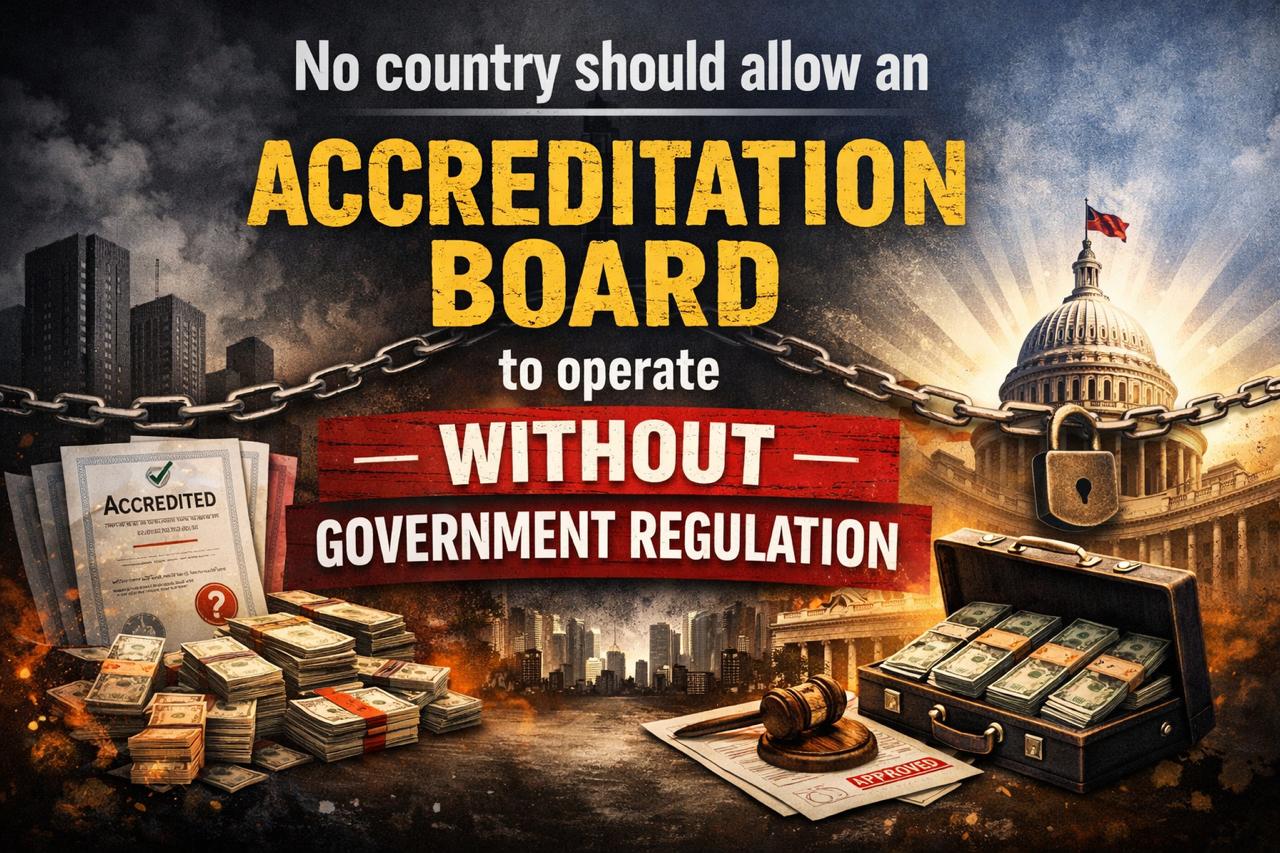

Accreditation was never meant to be a free-market badge business. It was conceived as a public-trust mechanism to verify competence, impartiality, consistency, and reliability in laboratories, hospitals, inspection bodies, and certification systems. When accreditation works properly, it strengthens confidence. When it becomes commercialized and weakly governed, it can create only the appearance of confidence. That is why no country should allow an accreditation board to operate without government regulation. 
Across many sectors, accreditation is now treated as a gateway to tenders, procurement, market access, and branding. This has created a dangerous shift. Instead of asking whether an organization is truly competent, the market often asks only whether it holds a certificate. Once accreditation becomes commercially necessary for survival, demand for certificates rises faster than demand for genuine quality. In such an environment, the pressure on accreditation boards is no longer only technical; it becomes financial. 
This is where the real risk begins. If accreditation boards are allowed to operate without firm national regulation, they can gradually drift from public-interest institutions into revenue-driven entities. The result is predictable: more focus on client acquisition, more pressure to expand, more tolerance for weak applicants, and less appetite for strict assessments. The number of accredited bodies increases, but confidence in quality does not. 
The problem is not accreditation itself. Accreditation remains one of the most valuable quality tools ever developed. The problem is unregulated accreditation. Without government control, a country may end up with accreditation boards that are technically recognized on paper but insufficiently accountable to the public, the regulator, or the end user. In healthcare, this is especially dangerous, because the final risk is not administrative failure — it is patient harm. In laboratories, it can mean inaccurate reports. In hospitals, it can mean unsafe systems. In certification, it can mean false confidence. 
A repeated field reality is that many organizations prepare intensely before assessment, present peak compliance during the audit, and then gradually dilute discipline once the certificate is granted. Documentation remains, logos remain, marketing remains — but actual quality practice weakens. Internal audits become routine paperwork. Corrective actions are written but not deeply implemented. Indicators are collected but not used. Staff are trained to answer auditors rather than to improve competence. If accreditation boards are not regulated strongly, they may continue to renew such systems on the basis of documents rather than outcomes. 
This is why government regulation is not interference; it is protection. A national government must define who can operate an accreditation board, under what legal structure, with what governance safeguards, with what public reporting obligations, and under what conflict-of-interest restrictions. Accreditation cannot be left to unchecked market forces. The board that grants trust must itself be governed by trust. That governance cannot be voluntary. It must be legal. It must be visible. And it must be enforceable.
Another serious concern is the conflict between accreditation and commercial interest. When an accreditation ecosystem becomes too dependent on fee income, subtle compromises begin to appear. Assessments may become predictable. Surveillance may become lighter. Nonconformities may become repetitive and minor. Rigor may weaken in the name of continuity. Honest quality professionals then find themselves sidelined, because the system starts rewarding appearance over substance. A weakly regulated accreditation market does not encourage deep quality work; it encourages certificate maintenance. 
At the global level, the problem becomes even more complex. International and regional recognition structures may promote expansion, harmonization, and peer acceptance, but they do not always provide visible public accountability at ground level. There is still no single publicly accessible dashboard showing how accreditation bodies actually perform in terms of complaints, suspensions, appeals, restrictions, or corrective actions. The public sees the logo, but not the real oversight record behind the logo. That gap between symbolism and transparency weakens confidence. 
This lack of transparency feeds a larger public money cycle. Patients and service users pay laboratories and hospitals expecting competence and safety. Laboratories and institutions then pay accreditation fees. Accreditation boards pay into regional and global structures for legitimacy, networking, and recognition. Money circulates through the system efficiently — but quality does not always flow back to the patient with equal certainty. If the final beneficiary of the system cannot see measurable quality outcomes, then the system risks becoming financially successful while morally weak.
No responsible country should tolerate such a situation. If an accreditation board is allowed to operate nationally, government regulation should require at least five non-negotiable controls.
First, there must be legal authorization. No private entity should be free to call itself an accreditation board and begin granting national or internationally marketable confidence marks without statutory or regulatory approval.
Second, there must be strict governance requirements. Ownership, beneficial control, board composition, impartiality mechanisms, and related-party interests must be fully disclosed.
Third, there must be public transparency. Accreditation boards should publish complaints received, actions taken, suspensions, withdrawals, appeal outcomes, assessor selection criteria, and performance indicators in a form accessible to the public.
Fourth, there must be conflict-of-interest barriers. An accreditation board should not directly or indirectly blur the line between assessment and consultancy, because the body that judges competence cannot also profit from preparing the candidate.
Fifth, there must be outcome-based oversight. Governments should not rely only on peer review documents and office files. They should evaluate whether accredited entities are actually performing better, more safely, and more consistently in the field.
Government regulation is also necessary because standards themselves are often written in language that many users interpret differently. When standards are complex, abstract, and open to multiple readings, assessment quality depends heavily on assessor competence and institutional integrity. In an unregulated accreditation environment, inconsistent interpretation becomes a commercial opportunity. In a regulated environment, it becomes a governance issue that can be monitored, corrected, and standardized.
Those who argue against regulation often say that accreditation must remain independent. That is true — but independence does not mean absence of law. Courts are independent, yet regulated by law. Banks are independent institutions, yet regulated by law. Healthcare professionals are independent in judgment, yet regulated by law. Accreditation boards should be no different. Technical independence in assessment must coexist with legal accountability in operation.
The central principle is simple: accreditation affects public trust, public safety, trade credibility, and often public money. Any institution that carries such influence cannot be left to self-regulate in silence. When accreditation boards operate without government regulation, the country creates a trust market without a trust guardrail.
If a nation genuinely wants accreditation to improve quality, it must stop treating accreditation boards as untouchable prestige entities and start treating them as accountable public-interest actors. The board that evaluates others must also be evaluated. The body that demands transparency must itself be transparent. The institution that sells confidence must first deserve confidence.
Conclusion
No country should allow an accreditation board to operate without government regulation because accreditation is too important to be left to commercial drift.
Without regulation, accreditation can become a badge business.
Without transparency, it can become a filtered lens.
Without accountability, it can become a silent compromise.
Without public oversight, it can become a trust symbol with uncertain substance. 
Accreditation must remain a mechanism of competence, not commerce; of public confidence, not private convenience.
When governments regulate accreditation boards firmly, transparently, and intelligently, they do not weaken accreditation.
They save it.
About the Author
Dr. Sambhu Chakraborty is a distinguished consultant in quality accreditation for laboratories and hospitals. With a leadership portfolio that includes directorial roles in two laboratory organizations and a consulting firm, , Dr. Chakraborty is a respected voice in the field. For further engagement or inquiries, Dr. Chakraborty can be contacted through email at info@sambhuchakraborty.com and contact information are available on his websites,https://www.quality-pathshala.com and https://www.sambhuchakraborty.com , or via WhatsApp at +919830051583